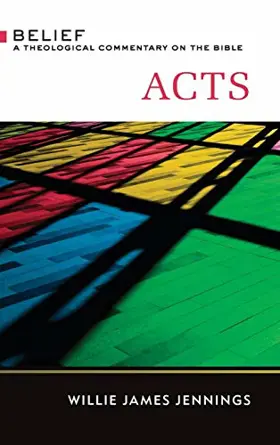
Acts
in Belief: Theological Commentary on the Bible
Pages
272
Publisher
Westminster John Knox
Published
5/5/2017
ISBN-13
9780664234003
Collections
This book appears in the following featured collections.
- Women and BIPOC by Jamie Davies
- Non-Western and BIPOC Commentaries by Best Commentaries
Reviews
DavidH
 May 2, 2026
May 2, 2026
Jennings' Acts (Belief, 2017) is a creative postcolonial and homiletical meditation rather than a commentary in any traditional exegetical sense, and readers should approach it accordingly. Its genuine strengths — attentiveness to diaspora as Acts' social context, sensitivity to Luke's portrayal of women, and sustained focus on the Spirit's agency — are real contributions. However, several serious problems warrant caution. Most troubling is Jennings' repeated characterization of God in explicitly erotic terms ("an erotic God," divine desire as "eros" and "sensuality," the resurrection as "closer to the erotic than the evidentiary"), language with no grounding in Luke's text and potentially dishonoring to God's holiness. He also calls Jesus' disruption of kinship networks "an act of utter terrorism" and describes God as "an extravagant busybody" — rhetorical flourishes that cross into irreverence. Exegetically, his treatment of Ananias and Sapphira (Acts 5) is a significant failure: he displaces the passage's own stated issue — lying to the Holy Spirit (5:3-4), as every mainstream commentary from Barrett and Bruce to Peterson and Bock consistently identifies — with an argument about "the idol of the couple," which he then uses as a platform for same-sex marriage advocacy entirely absent from the text. His characterization of Gamaliel as "the quintessential compromised intellectual" is dismissive beyond what the text warrants. He also asserts without justification that "all violence is religious violence," a claim internally inconsistent with his own economic analysis of the prison system elsewhere in the same volume. Throughout, contemporary political concerns — prison abolition, anti-nationalism, postcolonial critique — are read into Acts with a confidence the text itself rarely supports. Useful as a supplementary homiletical perspective when read critically; not reliable as a guide to what Luke actually wrote or meant.
G Ware
April 27, 2021
April 27, 2021
A very different sort of commentary. This does not provide the normal historical-grammatical exposition, or critical approach material. Instead, Jennings focuses on reading the text for contemporary theological reflection and preaching, noting the spiritual vibrancy of the narrative of Acts, and how the unfolding work of the Spirit among the Apostles informs the ongoing prophetic and spiritual work of the Church in the present. If you are looking for insights into the Greek text, or intertexuality or socio-rhetorical analysis, or textual criticism, or traditional exposition, you won't find it here. That said, it is useful, and inspiring for a very different purpose, and Jennings succeeds in accomplishing what he sets out to do. For the reader open to something out of the ordinary in their commentary library, this is a must.