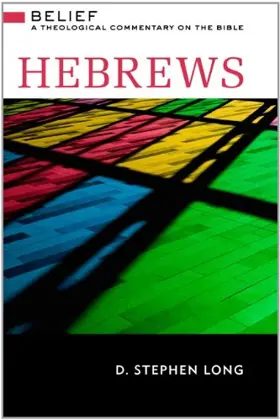
Hebrews
in Belief: Theological Commentary on the Bible
Pages
208
Publisher
Westminster John Knox
Published
9/16/2011
ISBN-13
9780664232511
The volumes in Belief: A Theological Commentary on the Bible from Westminster John Knox Press offer a fresh and invigorating approach to all the books of the Bible. Building on a wide range of sources from biblical studies and the Christian tradition, noted scholars focus less on traditional historical and literary angles in favor of a theologically focused commentary that considers the contemporary relevance of the texts. This series is an invaluable resource for those who want to probe beyond the backgrounds and words of biblical texts to their deep theological meanings for the church today.
Reviews
DavidH
 July 9, 2026
July 9, 2026
Long’s Hebrews is theologically rich, pastorally serious, and often stimulating, especially where it resists thin modern readings that reduce Hebrews’ world of priesthood, sacrifice, angels, heavenly sanctuary, divine speech, and pilgrimage to mere metaphor or antiquarian religion. Its central weakness, however, is that its theological imagination often outruns the exegetical controls of Hebrews itself. Long is right that Hebrews 8:1 is a major turning point: believers really do “have such a high priest,” enthroned in heaven, ministering in the true sanctuary, and giving present access to God. But he presses this insight into a Eucharistic and sacramental framework that Hebrews does not clearly teach, especially when he suggests that Christ’s single sufficient sacrifice can be “repeated in time” or that Christ “offers himself” today. The cumulative weight of Hebrews’ own argument cuts the other way: the old sacrifices were repeated because they were ineffective, whereas Christ’s sacrifice is once-for-all, complete, final, eternally effective, and followed by his sitting at God’s right hand. Hebrews certainly teaches Christ’s present heavenly ministry, but that ministry is best understood as intercession, application, and access grounded in the finished sacrifice—not as a continuing or repeated sacrificial offering. Likewise, Long’s use of “today” is too expansive: in Hebrews 3–4, “today” means God’s living summons to hear, believe, obey, and persevere, not a sacramental mechanism by which the sacrifice is re-presented. His critique of modern disenchantment is sometimes valuable, since Hebrews really does imagine angels, heavenly realities, divine judgment, and a living word from God; yet he can treat some philological and historical explanations—especially appeals to the Hebrew text behind the Septuagint—as though they participate in a broader modern tendency to demythologize Hebrews’ heavenly world, when they may simply clarify how Hebrews is using Scripture. His Nicene and Chalcedonian readings of Hebrews 1 are orthodox as dogmatic theology, but they sometimes blur the distinction between later doctrinal reflection and the text’s more immediate concern with the Son’s exaltation, enthronement, revelation, and superiority over angels. His sensitivity to anti-Jewish readings is welcome, but Hebrews still teaches a decisive old/new covenant transition: the old order was not false or evil, but preparatory, typological, and now fulfilled and surpassed by Christ’s perfect priesthood and sacrifice. Long’s commentary is valuable as ecclesial and theological reflection, but less reliable where it presents later sacramental, metaphysical, or denominational concerns as though they were the direct meaning of Hebrews.