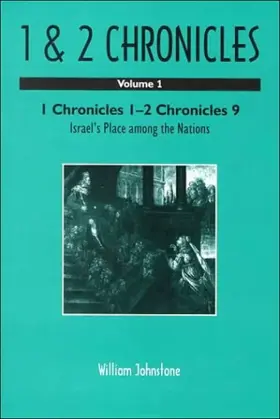
1 Chronicles 1–2 Chronicles 9: Israel's Place Among the Nations
in Library of Hebrew Bible/Old Testament Studies
Pages
181 pages
Publisher
Sheffield Academic Press
Published
5/1/1997
ISBN-13
9781850756934
This two-part commentary argues that Chronicles, placed as it is among the 'historical books' in the traditional Old Testament of the Christian church, is much misunderstood. Restored to its proper position as the final book in the canon as arranged in the order of the Hebrew Bible, it is rather to be understood as a work of theology essentially directed towards the future. The Chronicler begins his work with the problem facing the whole human race in Adam-the forfeiture of the ideal of perfect oneness with God's purpose. He explores the possibility of the restoration of that ideal through Israel's place at the centre of the world of the nations. This portrayal reaches its climax in an idealized presentation of the reign of Solomon, in which all the rulers of the earth, including most famously the Queen of Sheba, bring their tribute in acknowledgment of Israel's status (Volume 1). As subsequent history only too clearly shows, however, the Chronicler argues (Volume 2), that Israel itself, through unfaithfulness to Torah, has forfeited its right to possession of its land and is cast adrift among these same nations of the world. But the Chronicler's message is one of hope. By a radical transformation of the chronology of Israel's past into theological terms, the generation whom the Chronicler addresses becomes the fiftieth since Adam. It is the generation to whom the jubilee of return to the land through a perfectly enabled obedience to Torah, and thus the restoration of the primal ideal of the human race, is announced.
Reviews
DavidH
 May 8, 2026
May 8, 2026
Johnstone's two-volume commentary (Sheffield, 1997) offers genuine strengths — his identification of ma'al as a structuring theme, his attention to Masoretic paragraph markers, and his intertextual work linking Chronicles to Leviticus 5–6 and 25–26 are all valuable. However, the commentary is marred by serious problems. Methodologically, his programmatic dismissal of historicity as "at best a distraction," his labelling of Manasseh's repentance and Jehoiakim's exile as the Chronicler's "inventions," and his treatment of narrative data as "moveable counters" go further than even critical scholars like Japhet (OTL) or Knoppers (AYB), and stand sharply at odds with Thompson (NAC), who marshals Assyrian inscriptions supporting the very historicity Johnstone denies; Dillard (WBC) likewise argues that the deviations from orthodox practice in Hezekiah's Passover would be highly unlikely in a fabricated account, and most commentators allow that the differing accounts of Josiah's death may simply reflect different aspects of the same event — mortally wounded at Megiddo, dying upon arrival in Jerusalem — rather than irreconcilable theological constructions. To construct a theology of atonement and holiness from narratives one has already admitted are "inventions" and "moveable counters" is to build on sand by one's own reckoning, and the same self-undermining logic applies to his claim that the Chronicler's prophetic source citations refer to works that "probably never existed" — if an author fabricates his sources, how secure is the theology built upon them? His method compounds the problem: he treats every minute textual variation between Chronicles and Samuel–Kings as theologically significant and deliberate, while acknowledging that some may be accidents of transmission, resolving the tension by fiat ("any changes that exist are deliberate, no matter how small") — creating an unfalsifiable system in which every variation confirms the thesis. Theologically, his opening claim that Chronicles teaches "no easy blotting out of the guilty past" foregrounds legalistic reparation while backgrounding the Chronicler's own repeated celebrations of divine mercy, not least the centrepiece of the Chronicler's forgiveness theology in 2 Chronicles 7:14 — "If my people who are called by my name humble themselves, and pray and seek my face, and turn from their wicked ways, then I will hear from heaven, and will forgive their sin and heal their land" — a remarkably gracious and direct promise that sits poorly with Johnstone's framing; the effect is to present a harder, more legalistic picture of God than the text warrants. Several of his distinctive constructs — a jubilee chronology making the exilic generation the "fiftieth from Adam," a "duality in the one Deity," and the elevation of Pharaoh Neco to a "righteous gentile" alongside Cyrus — find no support in any other major commentary. His listing of "consulting the physicians" (2 Chr 16:12) as an abstract theological category of sin alongside idolatry and foreign alliances miscategorises what is specifically a criticism of Asa's failure to seek God — not a blanket condemnation of medical practice — potentially misleading readers about the Bible's stance on medicine, as Selman (TOTC) carefully notes. In short: stimulating to argue with and frequently illuminating on details, but too thesis-driven and too dismissive of the text's historical claims to serve as a reliable guide to what the Chronicler is actually saying.
Review of Biblical Literature (RBL) (John W. Wright)
 December 8, 1999
December 8, 1999
Among the Nations. Vol. 2: 2 Chronicles 10-36: Guilt and Atonement. JSOTSup 253-54 Sheffield: Sheffield Academic Press, 1997. Pp. 411 (Vol. 1); 300 (Vol. 2), Cloth, No Price Available, ISBN 1850756937. John W. Wright Point Loma Nazarene University San Diego, CA 92106 Given the explosion of the academic study of the biblical text, classical critical philological commentaries have tended to become scribal affairs Unless the commentator is extremely diligent, contemporary scholarship, rather than the biblical text itself, becomes the main dialogue partner for the commentator--and the reader of the commentary. The length of commentaries grows, yet the biblical text itself becomes a more distant voice, submerged beneath the cacophony of contemporary discussions. William Johnstone seeks to avoid this dilemma is his 700 plus page commentary on 1 and 2 Chronicles by selectively engaging contemporary scholarship and essentially foregoing a scholarly apparatus as he presents his reading of Chronicles to his audience. Yet his intent is not to present a postmodern exercise in the ideology of reading; Johnstone seeks to write "the inductive description of the material in the work itself, written with as few preconceptions as possible about what the theme or themes may turn out to be" (vol.1, p. 377). He methodically utilizes a concordance to trace the use of language within Chronicles and the rest of the Hebrew Bible, especially Leviticus, to construct "inductively" the message of the text, while comparing Chronicles to its Vorlage in Samuel--Kings. Johnstone helpfully summarizes his basic reading of Chronicles in introductions to each volume (vol.1, pp.9-23; vol.2, pp.9-20).
[Full Review]