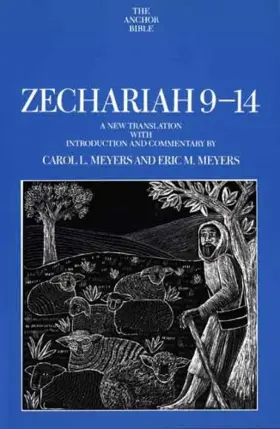
Zechariah 9–14
Pages
864
Publisher
Yale University Press
Published
1/1/1992
ISBN-13
9780300139761
This commentary and new translation of Zechariah 9-14 continues the appraoch adopted in the authors' 1987 Anchor Bible volume (25B) on Haggai and Zechariah 1-8. Authors Carol and Eric Meyers are perhaps uniquely qualified for this work because of their backgrounds in biblical archaeology and the social sciences. Employing the highest standards of pilological, literary, and historical research, they shed light on many enigmatic passages and offer an entirely new perspective on the history of Israel and its religion in the Persian period.
Whereas many scholars have viewed this point in the history of Israel as a time of deterioration of the beliefs and practices of biblical religion, the Meyerses paint a picture of an innovative and vibrant community struggling to maintain its identity within a rapidly changing world dominated by the mighty Greeks and Persians. In the face of this the author of Zechariah 9-14 makes extensive and transformative use of earlier biblical writings and of the sayings of previous prophets, and articulates a radically new view of Israel's future.
The Meyerses are the first modern commentators to see in these ancient texts the central role played by the Greco-Persian Wars in shaping the postexilic Restoration Community of Israel and its views of an expansive and glorious future. And althought Zechariah 9-14 is often regarded as the swan song of biblical prophecy, the Meyerses clearly demonstrate that the new modes of prophetic discourse found within this text helped biblical religion to meet one of the greatest challenges in its long history.
Whereas many scholars have viewed this point in the history of Israel as a time of deterioration of the beliefs and practices of biblical religion, the Meyerses paint a picture of an innovative and vibrant community struggling to maintain its identity within a rapidly changing world dominated by the mighty Greeks and Persians. In the face of this the author of Zechariah 9-14 makes extensive and transformative use of earlier biblical writings and of the sayings of previous prophets, and articulates a radically new view of Israel's future.
The Meyerses are the first modern commentators to see in these ancient texts the central role played by the Greco-Persian Wars in shaping the postexilic Restoration Community of Israel and its views of an expansive and glorious future. And althought Zechariah 9-14 is often regarded as the swan song of biblical prophecy, the Meyerses clearly demonstrate that the new modes of prophetic discourse found within this text helped biblical religion to meet one of the greatest challenges in its long history.
Collections
This book appears in the following featured collections.
- Commentaries by Female Scholars by Best Commentaries
Reviews
DavidH
 August 4, 2026
August 4, 2026
The Meyerses provide the most original and comprehensive historical-social treatment of Haggai and Zechariah. Their volumes are especially strong in philology, Persian-period history, archaeology, material culture, demographics, temple institutions and the social and economic realities of Yehud. Their translation deliberately attempts to preserve features of the Hebrew’s syntax, repetition and literary patterning, while the commentary consistently explains the texts within the lived world of the restoration community. Their reconstruction of Zechariah 9–14 as reflecting diminished political expectations and an increasing transfer of restoration hope toward supernatural and eschatological divine action is often illuminating, although some historical and sociological conclusions remain necessarily speculative. These volumes are dense and less immediately useful for Christian theological exposition than Boda or Petterson, but they regularly alter how the reader sees the concrete imagery and social implications of the text. For historical originality and specialist usefulness, they are outstanding.