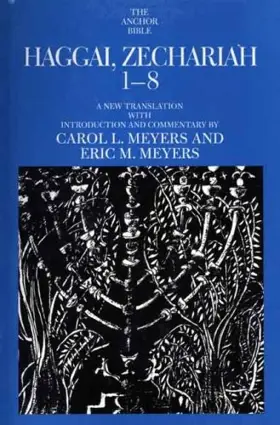
Haggai, Zechariah 1–8
Pages
552 pages
Publisher
Yale University Press
Published
1/1/1987
ISBN-13
9780300139754
Haggai and Zechariah 1–8, Volume 25B in the acclaimed Anchor Bible part of the Scripture known as the Minor Prophets, were written during a critical period in Israel’s history, the momentous return of the Jews from Babylonian exile. Following the conquest of Babylon by the Persian Empire, the Israelites sought to reestablish their ethnic and religious legacy in Judah. This was a time of profound turmoil and uncertainty, and Haggai and Zechariah provided a crucial measure of support and inspiration. They rallied Israel’s energies and exhorted their fellow countrymen to heed the word of God. Under their guidance the Jews restored the Temple at Jerusalem, which had been destroyed by the armies of Nebuchadnezzar. Together the two prophets guided Israel through an important transitional epoch, and reconciled the influences of Persia’s dominion with the sacred traditions of the Hebrew people.
In this illuminating new translation and commentary, Carol and Eric Meyers consider the Book of Haggai and the first eight chapters of the Book of Zechariah in a linguistic, social, and historical context. They underscore the literary artistry, the political acumen, and the prophetic authority of these fascinating volumes that proved so vital to the survival of Israel and the preservation of the Jewish faith.
In this illuminating new translation and commentary, Carol and Eric Meyers consider the Book of Haggai and the first eight chapters of the Book of Zechariah in a linguistic, social, and historical context. They underscore the literary artistry, the political acumen, and the prophetic authority of these fascinating volumes that proved so vital to the survival of Israel and the preservation of the Jewish faith.
Collections
This book appears in the following featured collections.
- Commentaries by Female Scholars by Best Commentaries
- TGC: Scholarly Commentaries by The Gospel Coalition
Reviews
DavidH
 August 4, 2026
August 4, 2026
The Meyerses provide the most original and comprehensive historical-social treatment of Haggai and Zechariah. Their volumes are especially strong in philology, Persian-period history, archaeology, material culture, demographics, temple institutions and the social and economic realities of Yehud. Their translation deliberately attempts to preserve features of the Hebrew’s syntax, repetition and literary patterning, while the commentary consistently explains the texts within the lived world of the restoration community. Their reconstruction of Zechariah 9–14 as reflecting diminished political expectations and an increasing transfer of restoration hope toward supernatural and eschatological divine action is often illuminating, although some historical and sociological conclusions remain necessarily speculative. These volumes are dense and less immediately useful for Christian theological exposition than Boda or Petterson, but they regularly alter how the reader sees the concrete imagery and social implications of the text. For historical originality and specialist usefulness, they are outstanding.
The Gospel Coalition
 June 1, 2024
June 1, 2024
“The Meyers treat Haggai and Zechariah 1– 8 not only as stemming from the same period of time,” observes Longman, “but also as two parts of the same composite work.” Also, because the Meyers are archaeologists, “their commentary is full of helpful historical and archaeological comments. The authors include an excellent bibliography.” Longman raves about the Meyers’ lengthy volume on Zechariah 9–14. He says, “This is a wonderfully written and researched commentary that I have found extremely provocative and largely persuasive.”
[Full Review]