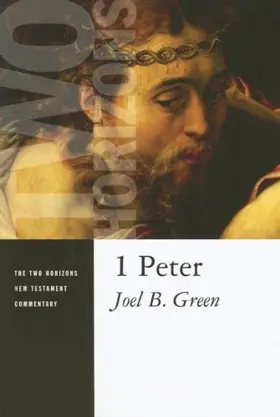
1 Peter
in Two Horizons New Testament Commentary
Pages
331
Publisher
Eerdmans
Published
1/1/2007
ISBN-13
9780802825537
Collections
This book appears in the following featured collections.
- The Pastor’s Bookshelf by Scot McKnight
- New Testament Commentaries & Monographs by Princeton Theological Seminary
- Nijay Gupta's Top NT Commentaries by Nijay K. Gupta
Reviews
DavidH
 August 12, 2026
August 12, 2026
Green is less a technical reference commentary than a sustained exercise in theological interpretation, but within that genre he is outstanding. His most fruitful emphasis is that conversion in 1 Peter involves the reconstruction of identity: new birth means a new autobiography, new relationships, resocialization into a new community, and incorporation into Israel’s story. Green also develops a persuasive account of “holiness of engagement,” refusing the usual choice between accommodation to the surrounding culture and sectarian withdrawal. His reading of the letter as calling believers to orient the whole of life around God rather than Rome’s systems of honor, status, and power is especially effective. It should be paired with a more technical commentary, but few volumes explain the theological logic of 1 Peter better.

Review of Biblical Literature (RBL) (Paul J. Achtemeier)
 September 1, 2008
September 1, 2008
This is an important book, not principally for its commentary on 1 Peter, although the commentary itself is a highly competent piece of work that will prove helpful to anyone who consults it. Rather, it is significant for its way of integrating an understanding obtained by a study of 1 Peter into an understanding of the relation of Christian Scripture, Old and New Testaments, and into the Christian theological enterprise. As such, it is a parade example of the stated intention of the commentary series of which it is a part. The book is divided into two major parts, a commentary in the usual sense—in this case paragraph by paragraph rather than verse by verse—and Theological Horizons, in which the theology of 1 Peter derived from the studies represented by the commentary is examined from several perspectives. A brief introduction to the letter as first-century literature set within the Roman Empire begins the volume, and it concludes with an extensive bibliography and several indices. Introductory matters (“Orientation”) are dealt with succinctly.
[Full Review]
