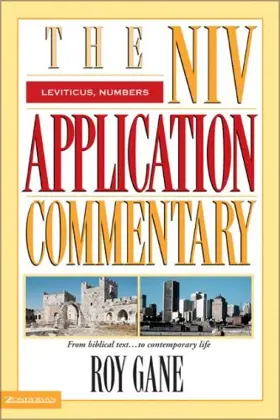
Leviticus, Numbers
Pages
848
Publisher
Zondervan
Published
1/1/2004
ISBN-13
9780310210887
Collections
This book appears in the following featured collections.
- Favorite Commentaries for Personal Study by Jeremy Pierce (parableman)
- Ultimate Commentary Collection: OT Expositional by John Glynn
Reviews
DavidH
 August 9, 2026
August 9, 2026
Gane’s volume is far more substantial exegetically than its NIV Application Commentary setting might suggest. His particular strength is explaining Levitical ritual as a coherent system: sacrifices, impurity, sanctuary pollution, priesthood and atonement are interpreted not as isolated ceremonies but as interconnected parts of Israel’s relationship with the divine presence. His discussion of the “part-for-all” principle, for example, offers a particularly helpful explanation of how defilement affecting one part of the sanctuary can implicate the whole without treating ritual impurity as a literal physical substance. Gane is strongly indebted to Milgrom, but he is not simply a popularizer; he frequently clarifies, develops and systematizes the ritual material in ways that make it considerably easier to understand. The movement from original meaning to theological principle and contemporary Christian significance is also unusually well handled. Some aspects of his sanctuary theology may profitably be compared with interpreters from other traditions, but overall this is one of the most useful treatments of Leviticus for understanding both what its rituals meant and why they matter.
G Ware
May 31, 2019
May 31, 2019
As far as pastoral commentaries on Leviticus go, Gane is a solid option. Taking Leviticus into contemporary application isn't easy, but Gane is able to work with the intention of the NIVAC bridge the gap between the original context and contemporary church.
Jeremy Pierce (parableman)
August 7, 2009
August 7, 2009
Roy Gane's NIVAC treats both Leviticus and Numbers and is much more recent than Wenham. Gane was a student of Jacob Milgrom and thus is well suited to write on these books. Strangely, Gane spends more time on the shorter Leviticus than he does on the longer Numbers. This series' strength is in providing a close look at the transition from interpreting the text in its original context to finding principles that apply in our contemporary context. It weakness is that the time spent on interpretation in the original setting is usually somewhat thin. It therefore never should serve as a primary commentary.
[Full Review]
