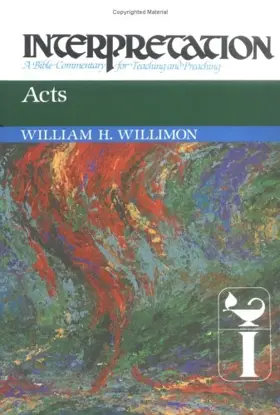
Acts
in Interpretation: A Bible Commentary for Teaching and Preaching
Pages
197
Publisher
Westminster John Knox
Published
1/1/1988
ISBN-13
9780804231190
Reviews
DavidH
 July 3, 2026
July 3, 2026
William H. Willimon’s Acts is vivid, provocative, and often pastorally bracing, with memorable calls to prayer, courageous witness, generosity, resistance to idolatrous power, and the church’s dependence on the risen Christ. Yet its homiletical force too often rests on speculative historical reconstructions and imprecise exegesis. Willimon rightly recognizes that Luke writes theological narrative rather than a modern transcript, and that Acts has real tensions with Paul’s letters; but he repeatedly turns literary shaping into allegations that Luke concealed, altered, or invented history—for example, by calling Luke 24 and Acts 1 contradictory, or by treating the disagreement between Paul and Barnabas as Luke’s cover story for a doctrinal schism. The evidence permits tensions and selectivity, but not such certainty about Luke’s motives. More seriously, Acts 15 plainly rejects circumcision and full Torah observance as conditions of Gentile salvation: Gentiles become God’s people through the same grace and faith as Jews, while the decree promotes holy, idolatry-free, and peaceable fellowship rather than proselyte conversion. Timothy’s circumcision is best read, if historical, as contextual missionary accommodation, not proof that Paul restored Torah as the basis of Christian identity. Likewise, Paul’s Areopagus speech does not offer “naturalistic drivel”: creation theology exposes idolatry, summons all people to repentance, and culminates in judgment through the risen Jesus. Acts 5 condemns Ananias and Sapphira for deceitful, status-seeking generosity, not for retaining private property; and Acts does not say that Jewish witness ceased or that God abandoned Israel. Finally, Willimon’s descriptions of God’s judgment on Herod as “pitiless” and “ugly” are rhetorically and theologically troubling, since the narrative presents judgment upon a persecuting ruler who accepts divine honours. A stimulating preaching resource, but too historically speculative and exegetically uneven to serve as a primary guide to Acts.
DavidH
July 3, 2026
July 3, 2026
William H. Willimon’s Acts is vivid, provocative, and often pastorally bracing, with memorable calls to prayer, courageous witness, generosity, resistance to idolatrous power, and the church’s dependence on the risen Christ. Yet its homiletical force too often rests on speculative historical reconstructions and imprecise exegesis. Willimon rightly recognizes that Luke writes theological narrative rather than a modern transcript, and that Acts has real tensions with Paul’s letters; but he repeatedly turns literary shaping into allegations that Luke concealed, altered, or invented history—for example, by calling Luke 24 and Acts 1 contradictory, or by treating the disagreement between Paul and Barnabas as Luke’s cover story for a doctrinal schism. The evidence permits tensions and selectivity, but not such certainty about Luke’s motives. More seriously, Acts 15 plainly rejects circumcision and full Torah observance as conditions of Gentile salvation: Gentiles become God’s people through the same grace and faith as Jews, while the decree promotes holy, idolatry-free, and peaceable fellowship rather than proselyte conversion. Timothy’s circumcision is best read, if historical, as contextual missionary accommodation, not proof that Paul restored Torah as the basis of Christian identity. Likewise, Paul’s Areopagus speech does not offer “naturalistic drivel”: creation theology exposes idolatry, summons all people to repentance, and culminates in judgment through the risen Jesus. Acts 5 condemns Ananias and Sapphira for deceitful, status-seeking generosity, not for retaining private property; and Acts does not say that Jewish witness ceased or that God abandoned Israel. Finally, Willimon’s descriptions of God’s judgment on Herod as “pitiless” and “ugly” are rhetorically and theologically troubling, since the narrative presents judgment upon a persecuting ruler who accepts divine honours. A stimulating preaching resource, but too historically speculative and exegetically uneven to serve as a primary guide to Acts.
G Ware
May 4, 2021
May 4, 2021
Willimon's concise, theological-pastoral commentary capably accomplishes the goals of the Interpretation series- specifically geared towards preaching. This one could have some more filling out, but it's still a good option for getting a sense of how the preacher can unpack Acts in a homiletical context.
A.E. Carnehl
August 21, 2014
August 21, 2014
I love this commentary, but I must say up front that William Willimon's Acts commentary in the Interpretation series SHOULD NOT supplement a technical or historical commentary on the book. It is very brief (at only 197 pages) and does not deal with every verse of Acts. However, as a devotional and homiletical commentary it is very good. Willimon must be a good preacher, because much of this commentary is written beautifully and persuasively. I find it to be extremely useful as the commentary I read either first or last in my list of Acts commentaries. I read it first to get the theological gist of a particular passage, or I read it last to acquire the numerous and brilliant applicational insights from Willimon. The Interpretation series' books are also inexpensive, which is a big plus for me.