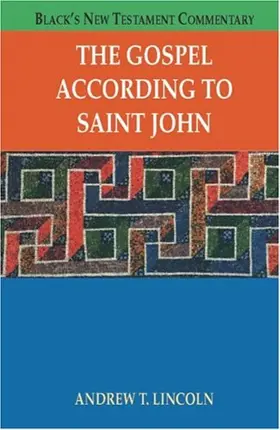
The Gospel According to St. John
in Black's New Testament Commentary
Pages
584
Publisher
Hendrickson
Published
1/1/2005
ISBN-13
9781565634015
Reviews
DavidH
 August 12, 2026
August 12, 2026
Lincoln’s moderately sized commentary punches considerably above its weight. He deliberately combines the literary, historical and theological dimensions of John while concentrating primarily on the Gospel’s final form, and his interpretation of the narrative through the interconnected motifs of witness, truth, judgment and lawsuit is one of the genuinely distinctive contributions of a modern commentary. His plot analysis shows Jesus paradoxically functioning as both accused and judge, with the apparent defeat of the cross becoming the decisive enactment of divine judgment, salvation and glory. I have more reservations about Lincoln’s judgments concerning historical embellishment and his reconstruction of Johannine community history, but these do not prevent the commentary from repeatedly illuminating the actual text.
Joel B. Green
 July 29, 2017
July 29, 2017
For useful, all-around companions, Andrew T. Lincoln’s contribution to Black’s New Testament Commentary is a welcome resource.

Palmer Theological Seminary Wynnewood, PA 19096 This new commentary on the Fourth Gospel provides both a worthy addition to the respected Black’s New Testament Commentary series and a serious replacement for its widely cited predecessor in that series, by J. N. Sanders and B. A Mastin, still useful but dated (1968). In this work, Lincoln both draws on a wide range of Johannine scholarship and bravely forges new paths at times, respecting consensus but seeking to break new ground. After an extensive introduction of the major issues debated in Johannine studies today, Lincoln’s work turns to commentary on passages followed by theological summary. The work is extremely well-written and readable. No reader of commentaries, even at a lay level, will have trouble understanding the prose. Most of his exegetical and literary judgments are sound and well-researched. At the same time, those expecting thorough scholarly interaction with secondary literature and vast citation of primary sources, as in Lincoln’s masterful two-volume Ephesians commentary or his earlier Paradise Now, Not Yet, will be disappointed; this work belong to a different genre of commentary. The series as a rule seeks to be accessible to students, requiring some limitation of details. The very rare footnotes are reserved for the translation, where they address textual variants and translation issues.
[Full Review]