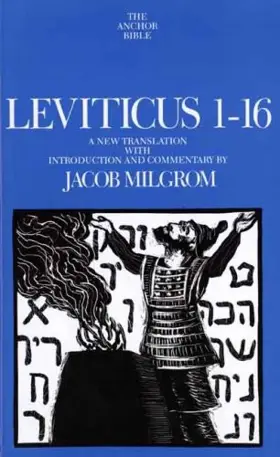
Leviticus
Leviticus 1–16
Pages
1184
Publisher
Yale University Press
Published
1/1/1998
ISBN-13
9780300139402
Leviticus 17–22
Pages
656
Publisher
Yale University Press
Published
1/1/2000
ISBN-13
9780300140569
Leviticus 23–27
Pages
848
Publisher
Yale University Press
Published
1/1/2001
ISBN-13
9780300139419
Collections
This book appears in the following featured collections.
- Recommended OT Commentaries by Denver Seminary Journal
- Tremper Longman's 5-Star Commentaries by Tremper Longman III
- Ultimate Commentary Collection: OT Technical by John Glynn
- Favorite Advanced OT Commentaries by Jeremy Pierce (parableman)
- Best Advanced OT Commentaries by Jason Gile
- Old Testament Advanced Commentaries by Moore Theological College Journal: Societas
- Top Old Testament Commentaries by Engaging Scripture (Nijay Gupta's Substack)
- Commentaries by Jewish Scholars by Best Commentaries
Reviews
DavidH
 August 9, 2026
August 9, 2026
Milgrom’s monumental three-volume commentary is the indispensable scholarly reference on Leviticus and arguably the most important modern contribution to the interpretation of the book. His reconstruction of the sacrificial and impurity systems, detailed analysis of priestly terminology, use of ancient Near Eastern and rabbinic sources, and treatments of atonement, sanctuary pollution, holiness and ethics repeatedly generate interpretations with which later commentators must engage. His nuanced treatment of kippēr, for example, distinguishes its particular force according to ritual context rather than imposing a single undifferentiated meaning. The commentary is enormous and often technically demanding, and some of Milgrom’s source-critical reconstructions and historical conclusions remain debatable. Yet even where one disagrees, the arguments are usually substantial and illuminating. No other commentary in this group contains as much original exegetical material that a serious interpreter of Leviticus simply cannot afford to overlook.

Milgrom has three separate volumes on Leviticus in the AB series, Leviticus 1–16 (2007), Leviticus 17–22 (2000), and Leviticus 23–27 (2001). These titles represent the pinnacle of technical scholarship for this book, and stand alone. Milgrom makes good use of contributions from anthropology and religious studies, particularly in his discussion of the systemic nature of the purity laws.
[Full Review]
Princeton Theological Seminary
 December 4, 2017
December 4, 2017
Jacob Milgrom is a Jewish scholar who has spent
a lifetime studying Leviticus.


Jeremy Pierce (parableman)
July 5, 2008
July 5, 2008
Jacob Milgrom has authored one of the most significant commentaries on any biblical book of our time. His Anchor Bible work takes up three large tomes (1991, 2000, 2001), with more detail than anyone should probably need on most issues. He's one of the foremost Pentateuch scholars in history, and no student or scholar should miss out on this work. He does both source criticism and final-form interpretation, with more emphasis on the latter. His source-critical views are much more conservative than the academic orthodoxy has held, e.g. he places P much earlier than the usual dating. There's also lot of history of interpretation in here, particularly with medieval Jewish sources. I consider this the most important scholarly commentary on Leviticus, and I suspect it will remain so for some time. I'm less confident that it will be helpful to those whose commentary use is primarily for teaching the Bible to those with no scholarly training, but it might prove a good reference work even if it's much too detailed for a busy expositor to wade through more carefully.
[Full Review]
Denver Seminary Journal
 June 16, 2008
June 16, 2008
The fruit of a life time of study by a major biblical scholar, this work provides the most detailed and thorough exegesis available, with full reference to comparative ancient Near Eastern, Qumran, Dead Sea Scroll, and Rabbinic sources.
[Full Review]
