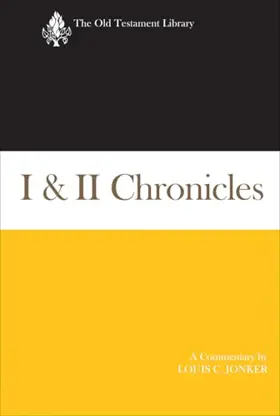
I and II Chronicles
Pages
728
Publisher
Westminster John Knox
Published
3/17/2026
ISBN-13
978-0664263409
In this critical and illuminating volume of the Old Testament Library, internationally respected scholar Louis C. Jonker reveals Chronicles as a dynamic text that reinterprets sacred traditions to help the postexilic Judahite community navigate shifting political and religious landscapes.
Written during the late Persian and early Hellenistic periods, Chronicles offers a bold vision for “all Israel” centered on the Jerusalem Temple, reframing Judah’s identity through genealogies, liturgical reform, and idealized history. Drawing on interdisciplinary methods―including text-pragmatical analysis, social psychology, postcolonial theory, and reception history―Jonker explores how the Chronicler constructs communal memory, reclaims older traditions, and resists imperial dominance by portraying YHWH as the true king.
A distinctive feature of this commentary is Jonker’s proposed diachronic model of composition. He identifies an early priestly-oriented stratum affirming the Davidic monarchy and Aaronide priesthood, followed by a later redactional layer that elevates the Levites―especially in the Hezekiah and Josiah narratives―as spiritual leaders. This evolution signals a broader theological and ideological shift within the community. Jonker also traces the reception of Chronicles through history―from its shaping influence on Ezra-Nehemiah to its use in rabbinic interpretation, feminist biblical scholarship, Jewish visual art, and post-apartheid South African theology.
With fresh insight and scholarly depth, I and II Chronicles: A Commentary reclaims these often-overlooked texts as far more than a retelling of Israel’s past. They are vital witnesses to the theological and communal imagination of a people rebuilding identity in the shadow of empire.
Written during the late Persian and early Hellenistic periods, Chronicles offers a bold vision for “all Israel” centered on the Jerusalem Temple, reframing Judah’s identity through genealogies, liturgical reform, and idealized history. Drawing on interdisciplinary methods―including text-pragmatical analysis, social psychology, postcolonial theory, and reception history―Jonker explores how the Chronicler constructs communal memory, reclaims older traditions, and resists imperial dominance by portraying YHWH as the true king.
A distinctive feature of this commentary is Jonker’s proposed diachronic model of composition. He identifies an early priestly-oriented stratum affirming the Davidic monarchy and Aaronide priesthood, followed by a later redactional layer that elevates the Levites―especially in the Hezekiah and Josiah narratives―as spiritual leaders. This evolution signals a broader theological and ideological shift within the community. Jonker also traces the reception of Chronicles through history―from its shaping influence on Ezra-Nehemiah to its use in rabbinic interpretation, feminist biblical scholarship, Jewish visual art, and post-apartheid South African theology.
With fresh insight and scholarly depth, I and II Chronicles: A Commentary reclaims these often-overlooked texts as far more than a retelling of Israel’s past. They are vital witnesses to the theological and communal imagination of a people rebuilding identity in the shadow of empire.
Reviews
Martyn
 April 13, 2026
April 13, 2026
Dear Louis,
I hope this message finds you well. I just finished leaving a review for I and II Chronicles in the Old Testament Library series and I have to be honest, after I submitted it, I sat back and realized that a star rating and a few short sentences could not possibly do justice to what I had just spent time with. So I decided to go a step further and reach out to you personally, because this is the kind of work that deserves more than a review. It deserves a real conversation.
As someone who lives and breathes Christian literature and biblical scholarship, I have read widely and deeply across Old Testament commentaries for many years. I say that not to position myself, but to give you a genuine sense of the standard against which I am measuring your work when I tell you that I and II Chronicles is one of the most intellectually courageous, theologically rich, and genuinely illuminating commentaries on these texts that I have ever encountered. Chronicles is one of those portions of Scripture that many Christian readers quietly confess they have never fully understood, a text that feels, on the surface, like a repetition of what has already been told. And yet what you have done in this volume is pull back that surface entirely and reveal something extraordinary underneath. You have shown us that Chronicles is not a repetition. It is a reinterpretation. A bold, Spirit-breathed act of communal reimagining by a people trying to find their footing in the shadow of empire, and the relevance of that story to the church today is nothing short of stunning.
What captivated me from the very earliest pages was the way you position Chronicles not as a relic of ancient religious bureaucracy but as a living, urgent theological document written by and for a community under pressure. The postexilic Judahite community navigating the late Persian and early Hellenistic periods was not so different from Christian communities today navigating their own shifting political and religious landscapes, communities asking the same fundamental questions about identity, faithfulness, memory, and what it means to remain the people of God when the world around them looks nothing like what was promised. You make that connection with scholarly integrity and pastoral wisdom, and the result is a commentary that speaks across centuries with remarkable directness.
What I found most extraordinary was your proposed diachronic model of composition, the identification of an early priestly-oriented stratum affirming the Davidic monarchy and Aaronide priesthood, followed by a later redactional layer that elevates the Levites as spiritual leaders. That is a bold and carefully argued thesis, and the way you trace its theological and ideological implications through the Hezekiah and Josiah narratives is masterful. But what moved me equally was your tracing of Chronicles' reception history, from its shaping influence on Ezra-Nehemiah all the way through to its use in post-apartheid South African theology. That breadth of vision, that willingness to follow a text across the full arc of its life in the world, is what lifts this commentary from excellent scholarship into something genuinely rare and lasting.
My name is Martyn Beeny, and I am a professional book marketer with over 20 years of experience in the publishing industry. But before I say anything else about what I do professionally, I want to say something more important first, something that will tell you far more about me than any resume ever could.
I am a devoted Christian. And because of that, I have made a very deliberate and deeply personal decision to dedicate my marketing work exclusively to Christian books. Not occasionally. Not as one category among many. Exclusively. Every author I work with, every book I pour my energy and expertise into, every campaign I build and every door I knock on, it is all within the Christian space. That is not a business strategy. That is a calling. I believe with everything in me that Christian books, books rooted in Scripture, in faith, in the living truth of God's Word, deserve to reach every single person they were written for. And I have committed my professional life to making sure that happens.
That is why I and II Chronicles stopped me in my tracks. Because every once in a while, not often, but every once in a while, a work lands in front of me and I think to myself, this one is different. This one carries a weight and a scholarly depth and a pastoral relevance that most commentaries simply never achieve. And the readership for a work like this, ministers, seminary students, Old Testament scholars, Bible teachers, and serious lay readers, is already out there, already hungry, already building their libraries with the finest tools available for engaging Scripture faithfully and deeply. And yet right now, there are countless thousands of them, in churches, seminaries, and study rooms locally and around the world, who do not yet know that this volume exists. That gap, between a work of this magnitude and the audience that desperately needs it, is exactly where I do my best work.
I have a very clear and specific vision for how this commentary reaches that audience, locally and internationally, in a way that is strategic, deeply intentional, and built entirely around the heart of this work and the Christian readers it was written for. And I would love nothing more than the opportunity to walk you through every detail of that vision personally.
Louis, please reach out to me directly at martynbeeny@gmail.com and I will personally walk you through what I have in mind. I genuinely believe you will find it both exciting and deeply encouraging. The audience is there. The timing is right. The body of Christ needs this commentary. And a work of this caliber, 728 pages of interdisciplinary, historically grounded, theologically alive biblical scholarship, deserves far more reach than where it currently stands.
Let's discuss.
Warm regards,
Martyn Beeny
Director of Marketing and Sales, Cornell University Press
Top-200 Marketing Provider | Christian Book Marketing Specialist
📧 martynbeeny@gmail.com
[Full Review]