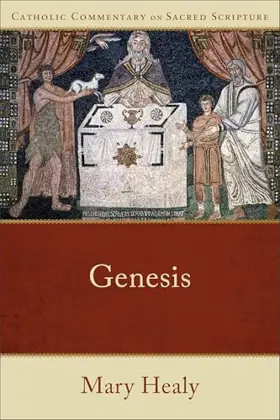
Genesis
in Catholic Commentary on Sacred Scripture
Pages
496
Publisher
Baker Academic
Published
4/28/2026
ISBN-13
9781540963703
In Genesis, respected scholar and popular speaker Mary Healy offers a detailed yet accessible interpretation of each passage of Genesis. She opens up the incomparable riches of this book as the beginning of the story of salvation and the foundation of biblical doctrines concerning God, creation, human nature, sexuality and marriage, sin, and God’s covenant with Israel. Drawing on Christian tradition, she shows how types and foreshadowing in Genesis point forward to the fulfillment of God’s plan in Christ.
Written from a standpoint of faith in the Holy Spirit’s inspiration of Scripture, CCSS Old Testament commentaries are designed for preaching, teaching, and applying Scripture to Christian life today.
Written from a standpoint of faith in the Holy Spirit’s inspiration of Scripture, CCSS Old Testament commentaries are designed for preaching, teaching, and applying Scripture to Christian life today.
Collections
This book appears in the following featured collections.
- Commentaries by Female Scholars by Best Commentaries
- Commentaries by Roman Catholic Scholars by Best Commentaries
Reviews
DavidH
 June 13, 2026
June 13, 2026
Mary Healy’s Catholic Commentary on Sacred Scripture volume on Genesis is warm, reverent, pastorally rich, and often spiritually illuminating, especially for readers seeking a Catholic canonical reading of Genesis. Its weakness is not impiety but exegetical overreach: Healy often reaches a legitimate theological destination while pressing details more confidently than the text warrants. Her Christological reading of Genesis 3:15 is valid in broad canonical terms, but calling it a “master key” risks making one verse control Genesis too tightly, collapsing the immediate serpent-human conflict, the unfolding seed-line, and later fulfilment in Christ. Some readings are evocative but speculative, such as the seedless/sterile tree, the woman as tabernacle, and the Sethite reading of Genesis 6, where her own appeal to “according to kind,” crossbreeding, crop-mixing, and boundary-crossing fits an angelic or tyrant-ruler interpretation more naturally than Sethite/Cainite intermarriage. Likewise, her Genesis 22 Passion typology is moving but sometimes over-detailed; the passage’s centre is Abraham’s fearful test, costly obedience, the threatened promise, and God’s provision, not every resonance with Isaac’s wood, Moriah, the third day, or Romans 8:32. Genesis 24 is sometimes over-romanticized, and her Joseph typology — Reuben as Nicodemus, the pit as death, twenty silver pieces as “only ten fewer” than Judas’s thirty, and Jacob/God sending the beloved son in “reckless love” — is homiletically suggestive but weaker than the narrative’s own emphases on providence, guilt, testing, Judah’s transformation, reconciliation, and God bringing good out of evil. Her intelligent-design sidebar also feels methodologically uneven: after rightly saying Genesis is not written to teach biology or cosmology, she imports modern debates about fossil gaps, probability, and irreducible complexity. Overall, this is a useful, faith-filled Catholic companion to Genesis, but best read alongside more disciplined exegetical commentaries; its recurring weakness is symbolic over-specification and typology that sometimes outruns the text.