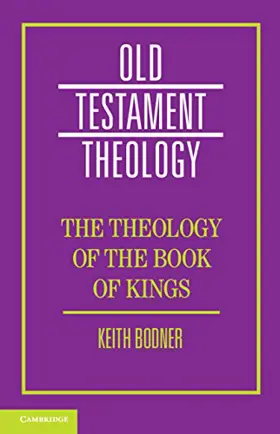
The Theology of the Book of Kings
Pages
279
Publisher
Cambridge University Press
Published
1/24/2019
ISBN-13
9781107568709
1 and 2 Kings unfolds an epic narrative that concludes the long story of Israel's experience with institutional monarchy, a sequence of events that begins with the accession of Solomon and the establishment of the Jerusalem temple, moves through the partition into north and south, and leads inexorably toward the nation's destruction and the passage to exile in Babylon. Keith Bodner's The Theology of the Book of Kings provides a reading of the narrative attentive to its literary sophistication and theological subtleties, as the cast of characters—from the royal courts to the rural fields—are variously challenged to resist the tempting pathway of political and spiritual accommodations and instead maintain allegiance to their covenant with God. In dialogue with a range of contemporary interpreters, this study is a preliminary exploration of some theological questions that arise from the Kings narrative, while inviting contemporary communities of faith into deeper engagement with this enduring account of divine reliability amidst human scheming and rapaciousness.
Collections
This book appears in the following featured collections.
- Top Old Testament Commentaries by Engaging Scripture (Nijay Gupta's Substack)
Reviews
DavidH
 August 8, 2026
August 8, 2026
Bodner’s volume is not a conventional verse-by-verse commentary, but as a theological companion to Kings it is exceptional. His strength lies in following literary and theological trajectories across the whole book, particularly the preservation of the Davidic line, the repeated threats to the dynasty and the significance of the apparently understated ending with Jehoiachin. Bodner’s attention to narrative echoes makes the final scene especially fruitful: connections with Joseph and earlier deliverance narratives help him show how Jehoiachin’s elevation leaves the Davidic promise unresolved but very much alive. His approach complements rather than replaces a detailed exegetical commentary, since many individual textual and historical questions necessarily receive little attention. But for understanding what Kings as a whole is doing theologically, and especially how its ending relates to its beginning and to the Davidic covenant, this is one of the most stimulating works I encountered.
Engaging Scripture (Nijay Gupta's Substack) (Nathan Lovell)
 October 1, 2021
October 1, 2021
Bodner is engaging and fun to read. This book works through Kings in large sections, focusing on how each contributes to the overall themes and theology of the book. It’s more oriented towards introducing the book overall than expounding individual passages, but scholars and non-specialist readers alike will get a lot out of this one.
[Full Review]