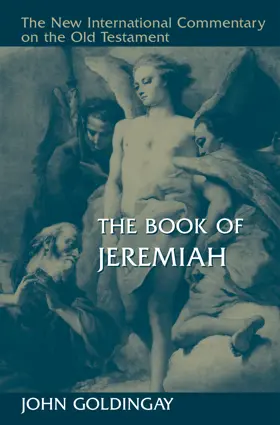
The Book of Jeremiah
in New International Commentary on the Old Testament
Pages
1063
Publisher
Eerdmans
Published
12/7/2021
ISBN-13
9780802875846
Of the Major Prophets, Jeremiah is perhaps the least straightforward. It is variously comprised of stories about the prophet Jeremiah, exchanges between Jeremiah and Yahweh, and messages directly from Yahweh—meaning a consciousness of form is essential to the understanding of its content. At times it is written in poetry, resembling Isaiah, while at other times it is written in prose, more similar to Ezekiel. And it is without doubt the darkest and most threatening of the Major Prophets, inviting comparisons to Amos and Hosea.
John Goldingay, a widely respected biblical scholar who has written extensively on the entire Old Testament, navigates these complexities in the same spirit as other volumes of the New International Commentary on the Old Testament series—rooted in Jeremiah’s historical context but with an eye always trained on its meaning and use as Christian Scripture. After a thorough introduction that explores matters of background, composition, and theology, Goldingay provides an original translation and verse-by-verse commentary of all fifty-two chapters, making this an authoritative and indispensable reference for scholars and pastors as they engage with Jeremiah from a contemporary Christian standpoint.
Table of Contents Introduction
John Goldingay, a widely respected biblical scholar who has written extensively on the entire Old Testament, navigates these complexities in the same spirit as other volumes of the New International Commentary on the Old Testament series—rooted in Jeremiah’s historical context but with an eye always trained on its meaning and use as Christian Scripture. After a thorough introduction that explores matters of background, composition, and theology, Goldingay provides an original translation and verse-by-verse commentary of all fifty-two chapters, making this an authoritative and indispensable reference for scholars and pastors as they engage with Jeremiah from a contemporary Christian standpoint.
Table of Contents Introduction
- 1. Background
- 2. Unity of Composition
- 3. Authorship and Date
- 4. Place of Origin, Occasion, and Destination
- 5. Canonicity
- 6. The Hebrew Text
- 7. Theology
- 8. Main Themes and Their Implications
- 9. Analysis of Contents
- 1. Prologue: An Introduction to the Scroll (1:1–19)
- 2. Part One: Confrontation, Exhortation, Warning (2:1–6:36)
- 3. Part Two (7:1–24:10)
- 4. An Interim Conclusion (25:1–38)
- 5. Part Three: The Die Cast and/or the Possibility of Restoration (26:1–36:32)
- 6. Part Four: The Calamity and the Aftermath (37:1–45:5)
- 7. Part Five: Messages about Other Peoples (46:1–51:64)
- 8. Epilogue (52:1–34)
Collections
This book appears in the following featured collections.
- Top Old Testament Commentaries by Engaging Scripture (Nijay Gupta's Substack)
Reviews
DavidH
 August 7, 2026
August 7, 2026
This is probably my first choice among modern Jeremiah commentaries. Goldingay combines detailed exegetical work with a genuinely fresh understanding of how the book came together and how it should be read. Particularly helpful is his distinction between the original settings of Jeremiah’s preaching, the scroll produced with Baruch, and the later form of the book, without pretending that undated passages can be assigned confidently to particular moments in Jeremiah’s career. His treatment of Jeremiah’s later “curators” also provides a sensible middle way between attributing everything directly to Jeremiah and treating later material as theologically inferior. Goldingay is especially good on Jeremiah as embodied theology, the book’s rich imagery, and its tendency to hold judgment and mercy, warning and inevitability, destruction and restoration together. Occasionally his willingness to leave theological tensions unresolved can be pushed further than I would, but this is an exceptionally original, substantial, and consistently useful commentary.