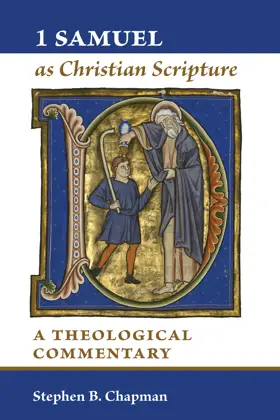
1 Samuel as Christian Scripture
Pages
357
Publisher
Eerdmans
Published
4/26/2016
ISBN-13
9780802837455
This work by Stephen Chapman offers a robustly theological and explicitly Christian reading of 1 Samuel. Chapman's commentary reveals the theological drama at the heart of that biblical book as it probes the tension between civil religion and vital religious faith through the characters of Saul and David.
Collections
This book appears in the following featured collections.
- Top Old Testament Commentaries by Engaging Scripture (Nijay Gupta's Substack)
Reviews
DavidH
 May 4, 2026
May 4, 2026
Chapman's 1 Samuel as Christian Scripture (Eerdmans, 2016) is a cultivated, intellectually serious work whose introduction — his engagement with the "book" as a theologically significant unit, his rebuttal of Sommer's midrashic objection, and his synthesis of Alter's literary approach with a genuinely theological intention — is worth consulting by any serious student of canonical and literary hermeneutics; but the commentary proper is compromised by a cluster of idiosyncratic and occasionally troubling positions that sit uneasily with the text and with the mainstream of Samuel scholarship. Most significant is his claim that Saul "adumbrates Christ" in his suffering and "overliving": the move is theologically confused, because Saul's dying-in-life is explicitly the consequence of his own disobedience and God's judicial withdrawal — punitive deterioration, not innocent redemptive suffering — and equating this with the Christ of Gethsemane and Calvary distorts the theological logic of the narrative, since Chapman's own assurance that such a christological interpretation "can honor the contours of the Old Testament narrative in a highly effective manner" is quietly refuted by the text's own explicit judgment on Saul's disobedience; no other major Samuel commentary — not Brueggemann (Int), Arnold (NIVAC), Tsumura (NICOT), Firth (ApOTC), Phillips (REC), Bergen (NAC), or McCarter (AYB) — supports this typological identification. More troubling still is his treatment of 1 Samuel 15, where he entertains "the possibility" that the narrator "actually means to portray" Samuel's execution of Agag as "reprehensible" — "perhaps Samuel is now depicted as making the opposite mistake by bringing battle into worship" — a reading unsupported by any narratorial signal and contradicted by the book's consistent presentation of Samuel as its orthodox spokesman; he then approvingly cites Buber's declaration that "Nothing can make me believe in a God who punishes Saul because he has not murdered his enemy" without substantive rebuttal, lending credence to what is, in effect, a protest against the divine command itself — a position verging on the derogatory toward God that no other serious evangelical or even moderate critical commentary endorses. His handling of 1 Sam 15:29 versus 15:11 and 15:35 is characteristically glib — "God, being God, absolutely does not regret, except when God does" — whereas Tsumura (NICOT), McCarter (AYB), and Klein (WBC) all show that naham in v. 29 functions in a different register (God will not reverse his judicial decision on Saul) from its uses in vv. 11 and 35 (God's personal grief over Saul's behavior), so there is no flat contradiction requiring the embarrassed irony Chapman deploys. His reading of Saul's removal of mediums (28:3) as "a worrisome signal" of prior spiritualist involvement rather than an act of Deuteronomic piety is a minority position against the near-consensus of Baldwin, Arnold, Bergen, and Firth, who rightly see it as obedience to Deut 18:10-11, making the subsequent resort to the medium all the more bitter. Chapman's characterisation of David's "sex appeal" as "contributing to the sense that he is God's chosen one" is an underdeveloped and misleading theological inference, and his footnote noting without explicit rejection the view that David's attractiveness to both men and women evidences "bisexuality" is an irresponsible half-endorsement of a fringe reading. The Thérèse of Lisieux conclusion is charming but finally a category error: a nineteenth-century French Carmelite's interior spirituality is not an adequate analogical lens for the thoroughly public, political, and covenantal theology of a book about the origins of Israelite monarchy, and the application says more about Chapman's Baptist pietist instincts (which he himself acknowledges) than about the text. There is also an internal inconsistency between Chapman's announced goal of letting literary presentation govern interpretation and his willingness to treat 2 Samuel 21–24 as the hermeneutical key to 1 Samuel — material he concedes is chronologically and compositionally displaced — quietly privileging the canonical-redactional perspective he claims to resist elsewhere; and despite the theological richness of the introduction, the exegetical engagement with Hebrew linguistics is thinner than in Arnold, Tsumura, Firth, or McCarter, so that the literary-theological readings sometimes float free of the grammatical anchors that would make them compelling rather than merely suggestive. The commentary is best read as an extended hermeneutical essay by a serious canonicist, paired with Firth (ApOTC) or Arnold (NIVAC) for exegetical control; readers should be forewarned that its willingness to leave the divine commands of 1 Samuel 15 as an open theological wound — rather than doing the harder work of canonical theodicy — reflects a fashionable academic discomfort with the Old Testament's portrayal of God that the text itself does not share.
CMROLLING
May 2, 2026
May 2, 2026
I sometimes wonder whether the genre of biblical commentary is really the most conducive for the enterprise of “theological interpretation.” In my experience, commentaries that embrace that label often only execute half of the equation well—the theological bit, or the biblical interpretation bit.
Chapman, however, may have set the bar for theological biblical commentary here. In addition to the engaging prose, exegetical insight is wed to theological confession throughout, showing all the while that theological interpretation of scripture is more of an approach, mindset, or set of commitments than it is a method.
Besides the exposition of 1 Samuel itself, the hermeneutical framework Chapman offers in the beginning and end of the book are also highly worthwhile—maybe even essential reading.
All in all, this is vintage Chapman and a great guide to 1 Samuel.