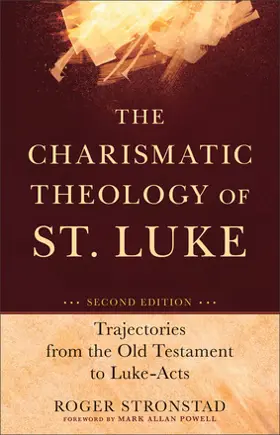
The Charismatic Theology of St. Luke: Trajectories from the Old Testament to Luke-Acts
Pages
144
Publisher
Baker Academic
Published
10/1/2012
ISBN-13
9780801048586
What is the meaning of the Holy Spirit's activity in Luke-Acts, and what are its implications for today? Roger Stronstad offers a cogent and thought-provoking study of Luke as a charismatic theologian whose understanding of the Spirit was shaped wholly by his understanding of Jesus and the nature of the early church. Stronstad locates Luke's pneumatology in the historical background of Judaism and views Luke as an independent theologian who makes a unique contribution to the pneumatology of the New Testament. This work challenges traditional Protestants to reexamine the impact of Pentecost and explores the Spirit's role in equipping God's people for the unfinished task of mission. The second edition has been revised and updated throughout and includes a new foreword by Mark Allan Powell.
- Contents
- Foreword by Mark Allan Powell
- Preface to the Second Edition
- 1. The Holy Spirit in Luke-Acts
- 2. The Holy Spirit in the Old Testament
- 3. The Holy Spirit in the Gospel of Luke
- 4. The Holy Spirit at Pentecost
- 5. The Holy Spirit in the Acts of the Apostles
- 6. The Charismatic Theology of St. Luke
- Indexes
Reviews
Caleb_Hoppus
 October 8, 2026
Roger wrote this book, originally as his thesis at Regent college, during a time in which Pentecostals were highly criticized for their lack of developed theology around their perspective on the Holy Spirit, Spirit Baptism, and Tongues. It is through this light that the book must be looked at. While there is much I disagree with pertaining to his perspectives, including a neglect of the impacts of Pauline Pneumatology on Lukan Pneumatology and writing from an incredibly strained and narrow perspective, he must be commended on his incredibly thorough and detailed effort to provide a basis for Pentecostal theological claims. He does this by tracing themes of the Holy Spirit through the Old Testament, the Deuterocanon, and Luke-Acts. If you are a classical Pentecostal who is interested in understanding the place of your theology in relation to scripture, this is the book for you. If you do not fall into this category, the books usefulness is limited and there is much you will disagree with.